Practise Example: Rugosa and Tabulata
Keynote
- The format of fossil identification report
- The differences between diagnosis and description
- The basic structure of the Rugosa and Tabulata
Format
A Fossil identification report should include:
Scientific name
Desicription: xxxxxxx
Paleoecology: xxxx
Geological ranges: XXXX
Sketch drawings should be included here. Remember to add a scale and mention the view or section you drawn.
Example
The following is an example from a scientific paper(Wang et al., 2025-Paleoworld) to help you learn how to describe a fossil. Note the format is different from our class.
Original Paper: Corals from the middle Visean (Mississippian) coral biostrome in the Yashui section, Guizhou, South China: Palaeogeographical implication
Kueichouphyllum sinense (Yü, 1931)
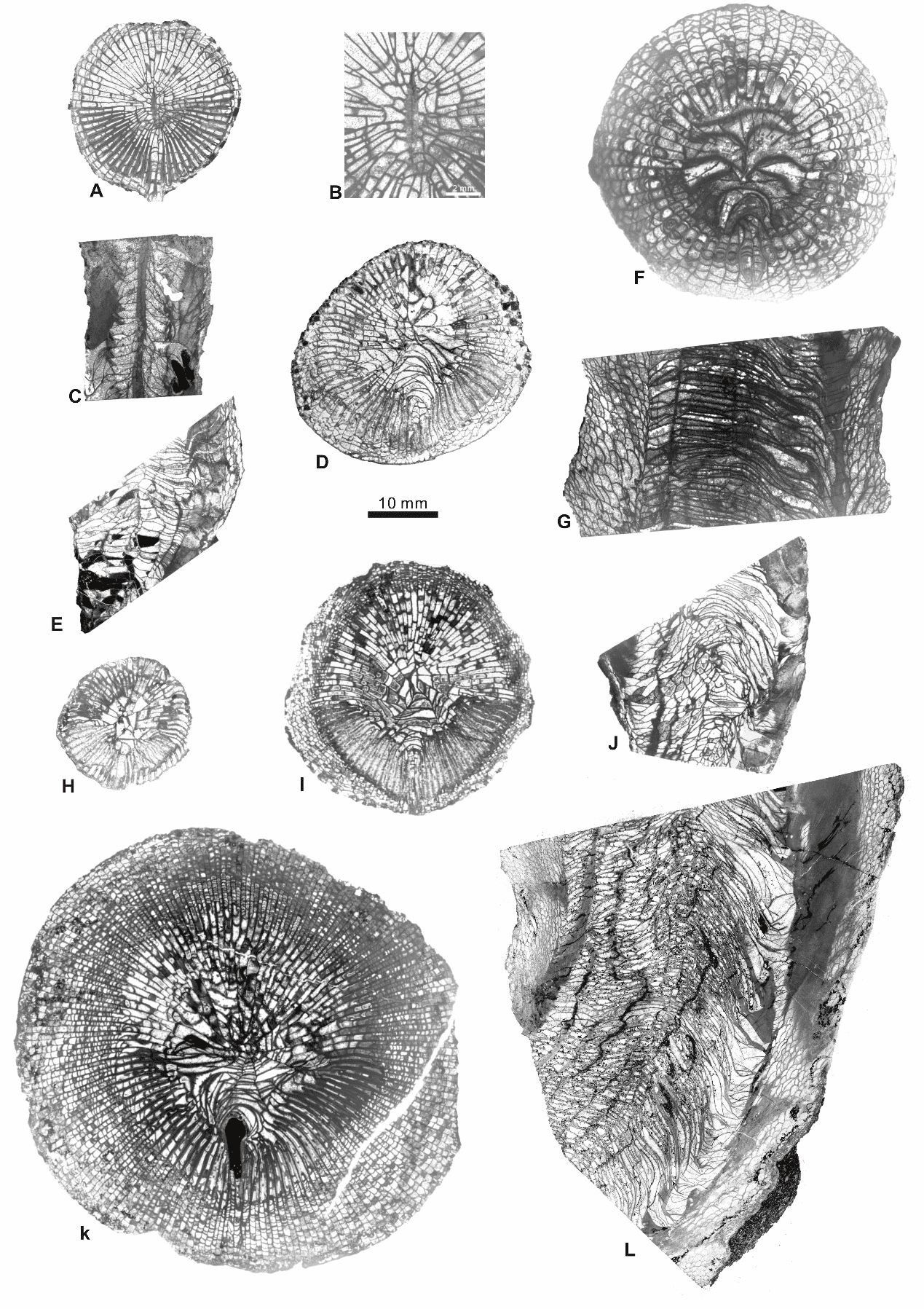
(Fig. 4H–L)
1931 Kueichouphyllum sinense – Yü, p. 24, text-fig. 3.
1933 Kueichouphyllum sinense – Yü, p. 71, pl. 9, figs. 1, 2a, b; pl. 10, fig. 1a–d.
1964 Kueichouphyllum sinense – Wu, p. 64, pl. 15, figs. 1, 2.
1977 Kueichouphyllum sinense – Kato and Niikawa, p. 247, pl. 1, figs. 1, 2; pl. 2, fig. 1.
1978 Kueichouphyllum sinense – Yu et al., p. 22, pl. 4, fig. 2.
1989 Kueichouphyllum sinense – Wu and Zhao, p. 97, pl. 19, fig. 5a, b.
1996 Kueichouphyllum sinense – Xu, p. 141, pl. 19, figs. 3–7; pl. 20, figs. 1, 2; pl. 21, figs. 1–3.
1999 Kueichouphyllum sinense – Liao and Rodríguez, p. 550, pl. 5, fig. 1a, b.
2000 Kueichouphyllum sinense – Igo and Adachi, p. 42, fig. 1.
2003 Kueichouphyllum sinense – Fan et al., p. 296, pl. 31, figs. 2a, b, 3a, b.
2012 _Kueichouphyllum sinense _– Lin et al., p. 343, pl. 1, figs. L, M.
Holotype: Specimen No. 4978 from the Visean (Yuanophyllum Zone) in Jungtung (Rongdong), Tingfan (Huishui) County, Guizhou, South China (Yü, 1931, p. 24, textfig. 3 and Yü, 1933, pl. 9, fig. 2a, b).
Diagnosis: Kueichouphyllum with 30–60 mm in diameter and 80–120 major septa. Major septa thickened in the tabularium, particularly in the cardinal quadrants. Minor septa long, reaching 1/2 of the radius. Dissepimentarium wide, composed of simple concentric dissepiments. Tabulae incomplete, arched strongly to the centre (Yü, 1931, 1933).
Materials: Fifty-three specimens with 83 transverse and 41 longitudinal thin sections.
Description: Large solitary rugose coral. In transverse section, corallite diameter 11.5–74 mm, the number of major septa 39–130 (Fig. 5B). The diameter and septa of the mature corallites 30–74 mm and 75–130, respectively. In the neanic stage, major septa long, strongly thickened in the tabularium of cardinal quadrant (Fig. 4H, I). Cardinal fossula prominent. Minor septa usually undeveloped and only a few dissepiments appear. In the ephebic stage, major septa very long, numerous, and still thickened in the tabularium of cardinal quadrant. Most of them extending to the axis and forming a kind of cobweb-like axial structure (Fig. 4K). Cardinal septum remarkably shortened and cardinal fossula prominent. Minor septa long, about 2/3 the length of major septa, and slightly penetrating into tabularium. However, minor septa of cardinal quadrants undeveloped in some corallites. Dissepimentarium wide, about 1/3–1/2 of the corallite radius in length. Dissepiments dense, generally concentric with less being herringbone form.
In longitudinal section, tabulae incomplete, in large vesicle form, and arched strongly towards the central part (Fig. 4J, L). Dissepiments mostly uniform, inclined steeply downwards to the tabularium. Dissepiments 13–15 rows. The innermost series nearly upright. Tabulae number 10–12 per 5 mm.
Remarks: These specimens are assigned to the genus Kueichouphyllum based on the features of long and numerous major septa, well-developed minor septa, and wide dissepimentarium. According to the corallite diameter and number of major septa, the described specimens are identical to K. sinense from the Visean–Serpukhovian strata in South China (Yü, 1933; Xu, 1996; Lin et al., 2012).
Occurrence: This species is from the strata underneath the biostrome and stages 1 to 3 of the coral biostrome (middle Visean) in the YS-A, YS-B and YS-C sections, Guizhou, South China.
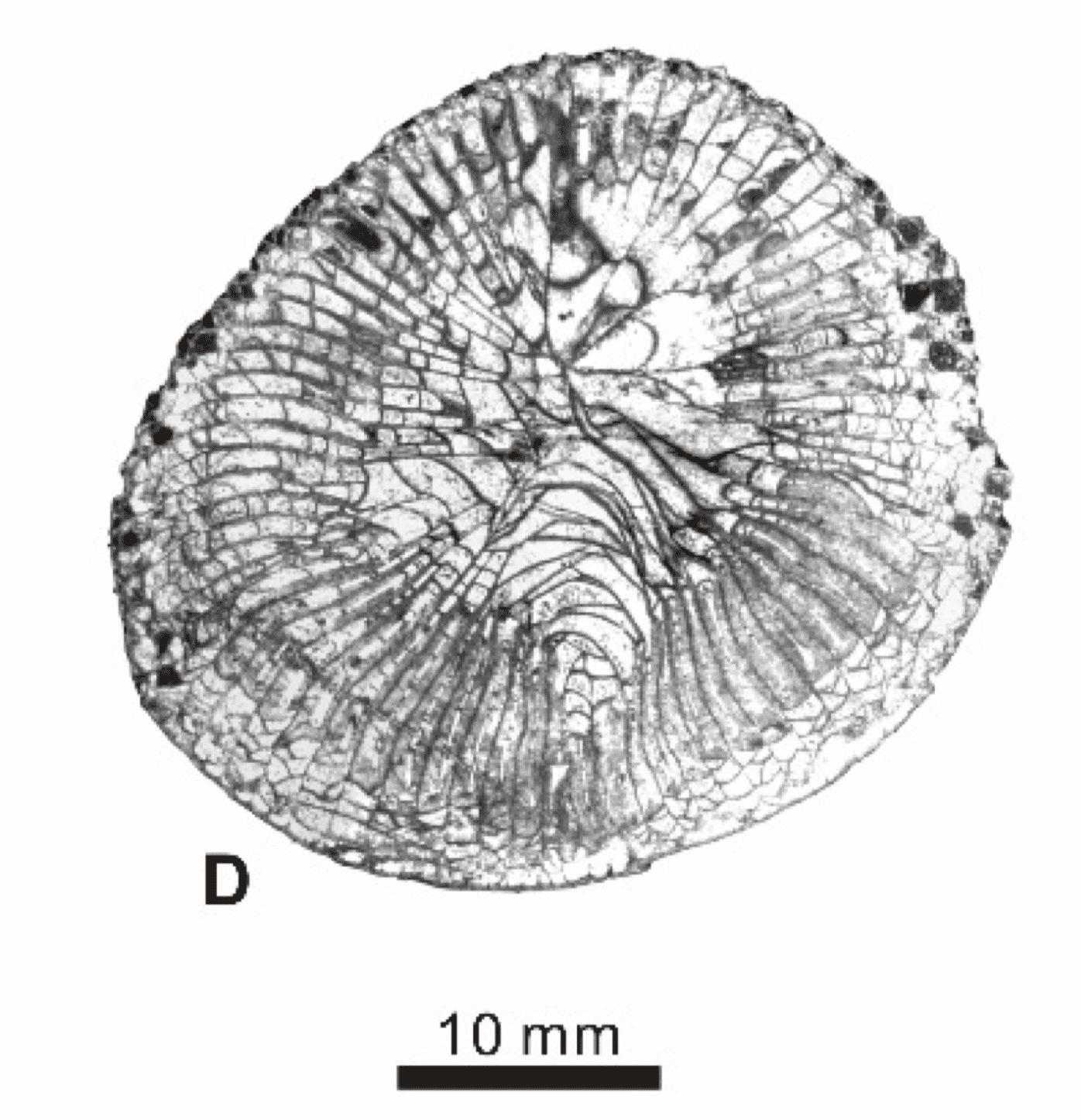
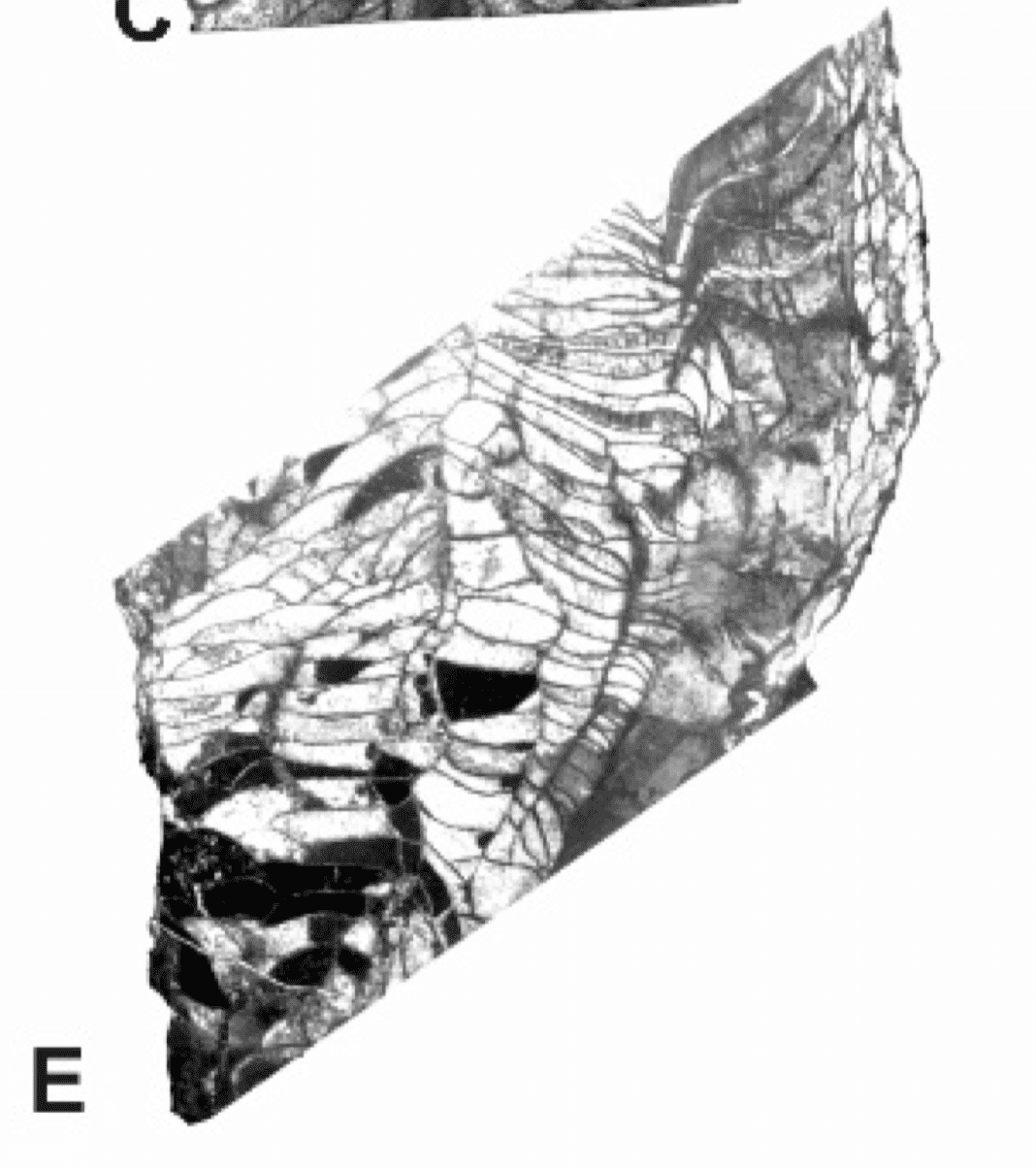
Heterocaninia guixianense Xu in Jia et al., 1977
(Fig. 4D, E)
1977 Heterocaninia guixianense – Xu in Jia et al., p. 176, pl. 65, fig. 2.
1982 Heterocaninia guixianense – Jiang, p. 112, pl. 69, fig. 2.
1987 _Heterocaninia guixianense _– Tan et al., p. 136, pl. 22, fig. 5.
1996 Heterocaninia guixianense – Xu, p. 133, pl. 14, fig. 6a, b; pl. 17, fig. 6; pl. 18, fig. 6a, b; pl. 19, figs. 1, 2; pl. 24, fig. 3.
Holotype: Specimen IV 38532 from the Visean in Guixian, Guangxi, South China (Jia et al., 1977, p. 176, pl. 65, fig. 2).
Diagnosis: Heterocaninia with a diameter of 30–40 mm (maximum 50 mm) and 6080 major septa (maximum of 106). Major septa thinner in the inner and outer parts and thickened in the middle part. Some major septa reaching the centre. Minor septa short or absent. Dissepimentarium width about 1/3–1/2 of the radius, consisting of regular simple dissepiments. Tabulae relatively complete and flat, or slightly domed in the central part (Xu, 1996).
Materials: Two specimens with three transverse and two longitudinal thin sections. The outer walls of the specimens are slightly eroded.
Description: Moderate to large solitary rugose coral. In transverse section, corallite diameter 26–32 mm and major septa 74–75 in number (Fig. 5A). Major septa long, with 1/3 or less of them extend to the centre and the others stop at about 2/3 of the radius. Major septa thickened in the tabularium of cardinal quadrants (Fig. 4D). Cardinal septum shortened, leaving a conspicuous cardinal fossula. Minor septa short and partly developed. Dissepimentarium 1/4 of the radius, containing 4–6 rows of dissepiments, mostly in herringbone form with less concentric form.
In the longitudinal section, tabulae relatively complete with less incomplete ones in vesicle form, flat or slightly domed upward in the central part (Fig. 4E). Dissepiments in elongated vesicle form, steeply descending to the tabularium. Tabulae 8–9 per 5 mm.
Remarks: Most features of the described specimens fit well within the species H. guixianense from the Visean Huangjing Formation in Guangxi (Xu, 1996), in aspects of having similar diameter and septal number, a few major septa reaching the centre, and relative complete tabulae.
Occurrence: This species occurs at the stage 1 of the coral biostrome (middle Visean) in the YS-A and YS-B sections, Guizhou, South China