
3.1 Fusulinid
Mind Map
Fusulinid
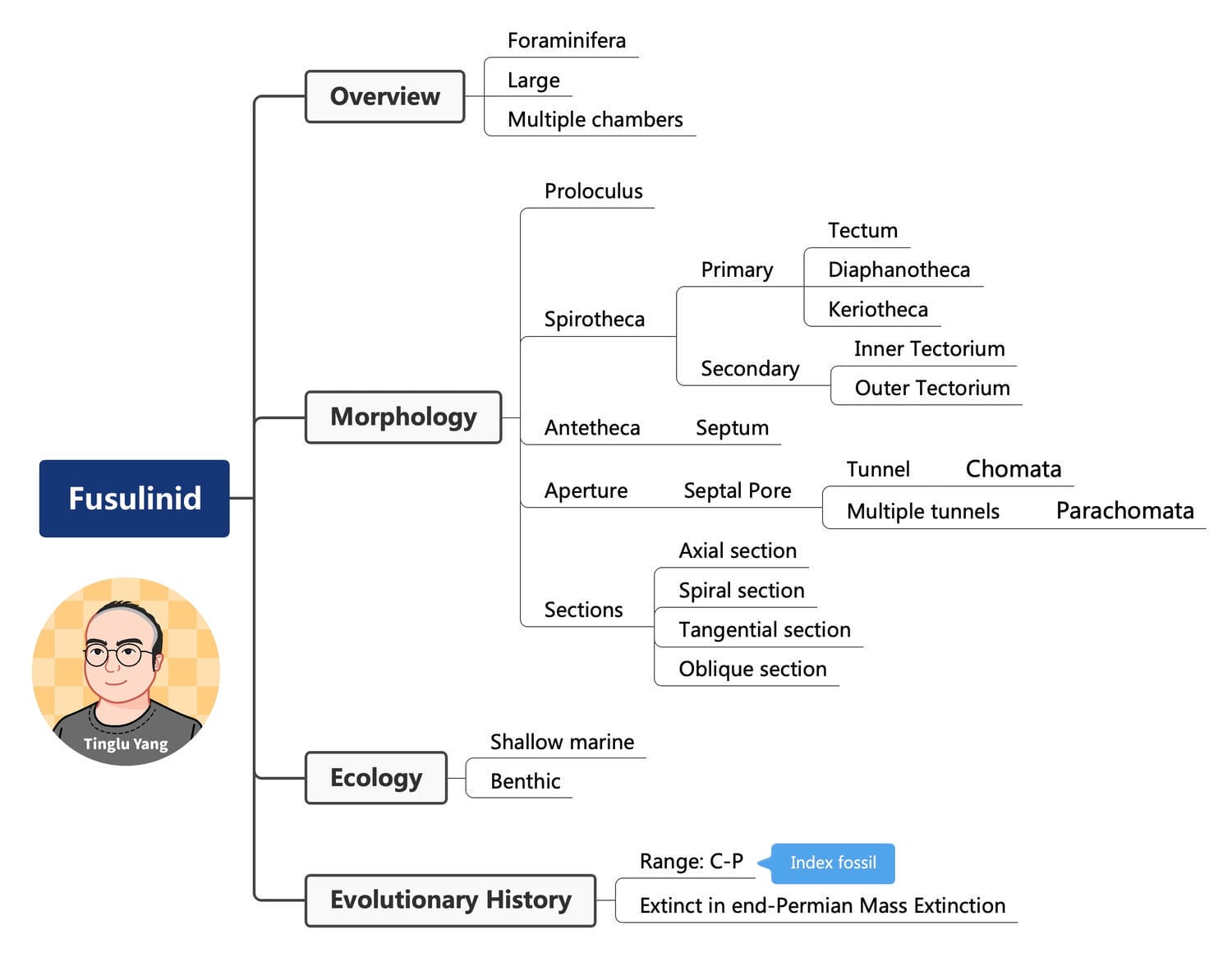
Morphology and Glossary
Fusulinid
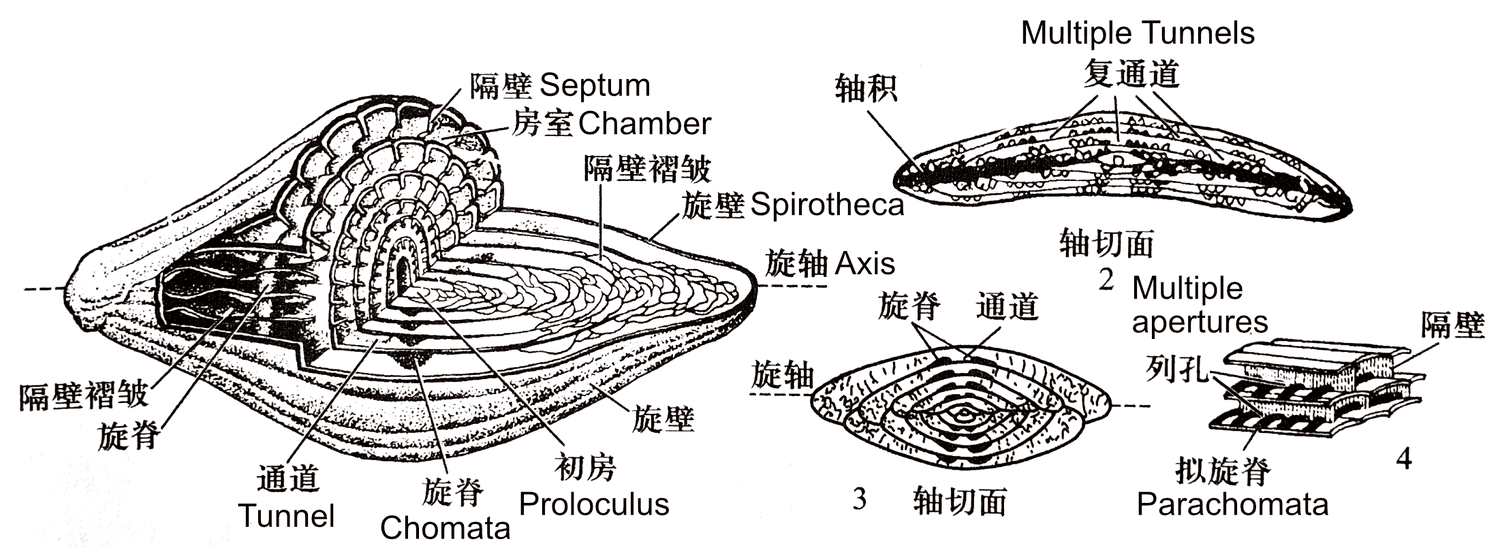
Glossary
| 中文 | 英文 | 音标(美式) |
|---|---|---|
| 初房 | Proloculus | /proʊˈlɑːkjʊləs/ |
| 旋壁 | Spirotheca | /ˌspaɪrəˈθiːkə/ |
| 前壁 | Antecheca | /ˌæntəˈkiːkə/ |
| 口孔 | Aperture | /ˈæpərtʃər/ |
| 隔壁 | Septum | /ˈsɛptəm/ |
| 隔壁孔 | Septal pore | /ˈsɛptəl pɔːr/ |
| 房室 | Chamber | /ˈtʃeɪmbər/ |
| 通道 | Tunnel | /ˈtʌnəl/ |
| 旋脊 | Chomata | /ˈkoʊmətə/ |
| 拟旋脊 | Parachomata | /ˌpærəˈkoʊmətə/ |
| 致密层 | Tectum | /ˈtɛktəm/ |
| 透明层 | Diaphanotheca | /daɪˌæfəˈnoʊθɪkə/ |
| 蜂巢层 | Keiotheca | /ˌkiːoʊˈθiːkə/ |
| 内疏松层 | Inner tectorium | /ˈɪnər tɛkˈtɔːriəm/ |
| 外疏松层 | Outer tectorium | /ˈaʊtər tɛkˈtɔːriəm/ |
| 单层式 | Monolamellar | /ˌmɒnoʊləˈmɛlər/ |
| 双层式 | Bilamellar | /ˌbaɪləˈmɛlər/ |
| 三层式 | Trilamellar | /ˌtraɪləˈmɛlər/ |
| 四层式 | Quadrilamellar | /ˌkwɒdrələˈmɛlər/ |
Explanations
Shell Structure & Growth
- Involute test\nA type of shell in which the outermost whorl completely encloses the earlier whorls, such that only the final whorl is externally visible.
- Proloculus\nThe initial chamber of the test, usually round and located at the center of the shell.
- Opening of the proloculus\nA circular aperture on the proloculus through which cytoplasm extends outward.
- Spirotheca\nThe spiral outer shell wall formed by periodic secretion of shell material as the cytoplasm grows; it envelops the proloculus and inner chambers.
- Axis (of coiling)\nAn imaginary line around which the spirotheca grows and extends at both ends, serving as the central coiling axis of the test.
- Whorl\nA complete coil of the spirotheca around the axis.
- Chamber\nThe narrow, elongated space formed between a septum and the newly developed anterior wall.
- Antetheca\nThe anterior wall periodically formed by the inward bending of the spirotheca at its front end.
- Aperture\nThe external opening at the base of the antetheca through which cytoplasm emerges.
- Single aperture\nA test with only one aperture for cytoplasmic extrusion.
- Multiple apertures\nA test with several apertures at the base of the antetheca.
- Septum\nA former anterior wall that becomes internalized and functions as a partition between chambers after being enclosed by a new chamber.
- Septal pore\nAn opening at the base of a septum, formerly an aperture, allowing cytoplasmic communication between chambers.
- Tunnel\nA longitudinal passage formed by aligned septal pores, enabling cytoplasmic flow between chambers.
- Multiple tunnels\nThe presence of more than one tunnel in the test structure.
- Chomata\nPaired ridges of secondary deposits on both sides of a single tunnel, forming spiral patterns.
- Parachomata\nMultiple ridges formed beside multiple tunnels, spiral in pattern and less paired than chomata.
- Axial filling\nSecondary calcite deposits filling the axial region of the shell.
Shell Sections
- Axial section\nA cut through the proloculus parallel to the coiling axis, used to study the internal spiral growth.
- Spiral section (Median section)\nA section through the proloculus perpendicular to the axis.
- Tangential section\nA section parallel to the axis but not passing through the proloculus.
- Oblique section\nA diagonal cut not aligned with any standard plane, often used when axial cuts are not possible.
Wall Composition
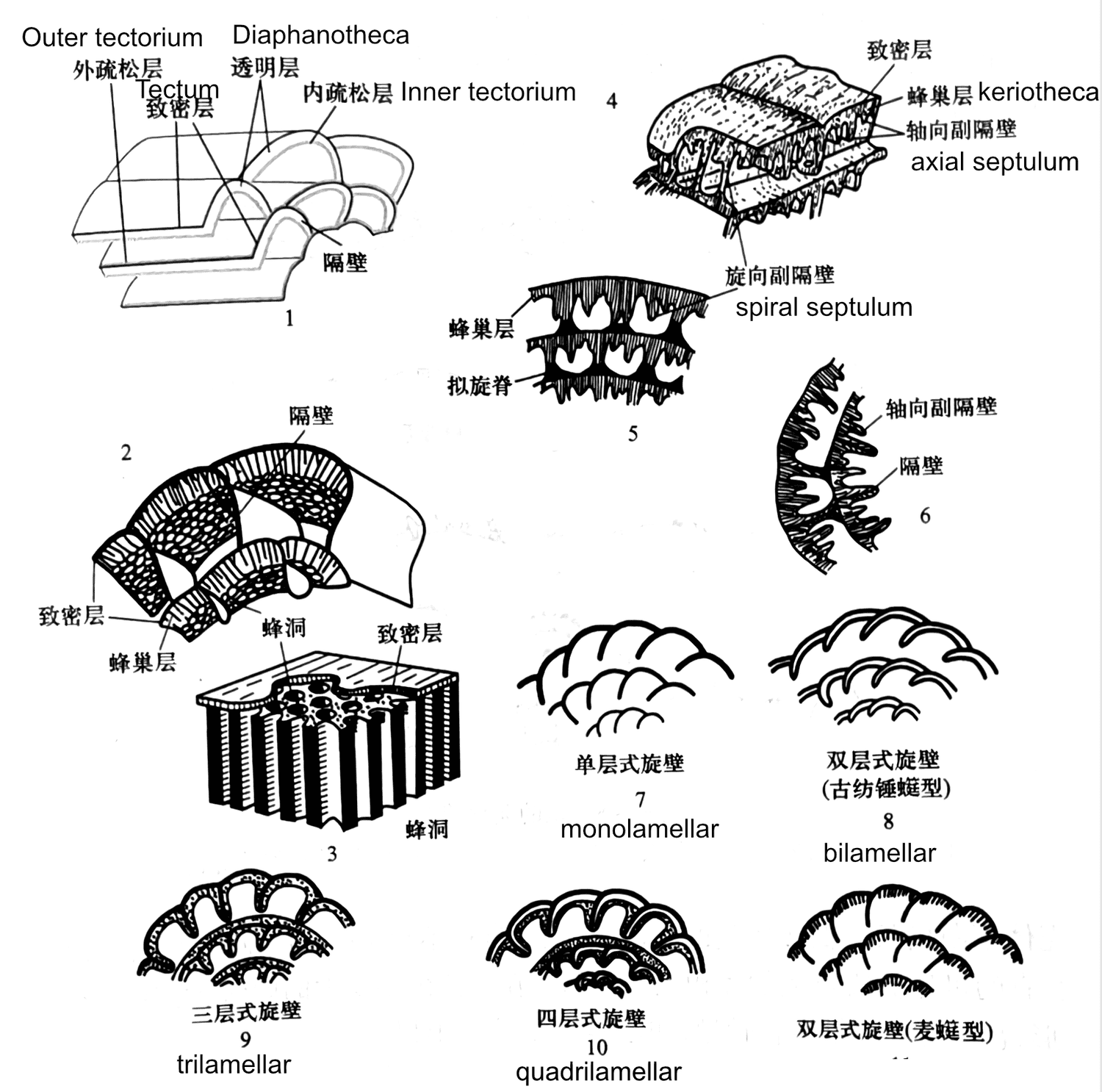
- Calcareous multilayered shell\nThe shell structure of fusulinids, composed of multiple layers of calcitic material.
Primary Wall Layers
Tectum
A thin, dark, dense outer layer visible as a black line under a microscope.
Diaphanotheca
A light-colored, translucent layer inside the tectum.
Keriotheca
A thick, honeycomb-like inner layer, comb-like in cross-section.
Secondary Wall Layers
- Outer tectorium\nExternal secondary deposit outside the tectum.
- Inner tectorium\nInternal deposit lining the shell's interior.
Wall Structure Types
- Monolamellar wall\nA shell wall consisting only of the tectum or Protheca (a primitive wall composed of a single layer of pale, loose material in some early fusulinids).
- Bilamellar wall
- Palaeofusulinid type: Tectum + Diaphanotheca.
- Triticid type: Tectum + Keriotheca.
- Trilamellar wall
- Profusulinellid type: Tectum + Inner and outer tectorium.
- Verbeekinid type: Tectum + Keriotheca + Inner tectorium.
- Quadrilamellar wall
- Fusulinellid type: Tectum + Diaphanotheca + Inner and outer tectorium.
Vocabulary
| 单词 | 音标 | 中文释义 |
|---|---|---|
| Monora | [məˈnɔːrə] | 单一的,单一的(通常用于描述某些事物具有单一的特征或结构) |
| Protozoan | [ˌproʊtəˈzoʊən] | 原生动物(单细胞动物,属于原生生物界) |
| symbionts | [ˈsɪmbaɪənts] | 共生生物(指两种不同生物之间相互依赖、共同生活的生物) |
| granular | [ˈɡræŋjʊlər] | 颗粒状的(具有颗粒状结构或外观的) |
| pseudopodia | [ˌsudəˈpoʊdiːə] | 假足(原生动物的一种运动或摄食的临时性细胞突起) |
| Foraminifera | [ˌfɔːrəmɪˈnɪfərə] | 有孔虫(一类具有钙质或几丁质外壳的海洋原生动物) |
| chamber | [ˈtʃæmbər] | 房间;腔室(建筑物中的房间,或物体内部的空腔) |
| uniserial | [ˌjuːnɪˈsɪəriəl] | 单列的(以单一列排列的,通常用于描述某些结构或物体的排列方式) |
| biserial | [ˌbaɪˈsɪəriəl] | 双列的(以两列排列的) |
| planispiral | [ˈpleɪnɪspɪrəl] | 平面螺旋形的(在平面上呈现螺旋形状的,如同蜗牛壳的形状) |
| trochospiral | [ˌtrɑːkəʊˈspɪrəl] | 涡旋状螺旋的(一种螺旋形状,类似于海螺壳的形状) |
| Proloculus | [prəˈlɒkjʊləs] | 原始室(在某些无脊椎动物的外壳或结构中,最初的、最小的腔室) |
| Spirotheca | [ˌspaɪrəʊˈθiːkə] | 螺旋壳(具有螺旋形状外壳的结构或生物) |
| Antetheca | [ˌæntɪˈθiːkə] | 前壳(位于某些生物外壳或结构前面的部分) |
| Septum | [ˈseptəm] | 隔板;隔壁(分隔两个腔室或空间的结构) |
| Aperture | [ˈæpərtʃər] | 开口;孔隙(物体上的孔洞或开口,允许物质或光线通过) |
| Tangential | [tænˈdʒenʃəl] | 切线的;切向的(与切线有关的,或沿着切线方向的) |
| Anthozoa | [ænθəʊˈzoʊə] | 花虫纲(腔肠动物门的一纲,包括海葵、珊瑚等) |
| Cnidaria | [naɪˈdɑːriə] | 刺胞动物门(包括水母、海葵、珊瑚等具有刺细胞的动物) |
| Polyp | [ˈpɒlɪp] | 花虫;息肉(刺胞动物的一种生命形态,通常呈圆柱形,有口和触手) |
| Medusa | [məˈdjuːsə] | 水母型(刺胞动物的一种生命形态,通常呈伞形,能自由游泳) |
| Solitary | [ˈsɒlɪtəri] | 孤独的;单独的(独自生活或存在的,不与其他个体聚集的) |
| colony | [ˈkɒləni] | 群落;殖民地(同种生物聚集生活的群体,或一个国家在海外开拓的居留地) |
| Ceroid | [ˈsɪərɔɪd] | 珊瑚状的(形状或结构类似珊瑚的) |
| Asteroid | [ˈæstɪrɔɪd] | 星状的;小行星(形状像星星的,或太阳系中的小天体) |
| Thamnasteroid | [ˌθæmnəsˈtɪərɔɪd] | 灌木星状的(形状像灌木且呈星状的) |
| Aphroid | [ˈeɪfrɔɪd] | 无花的;无孔的(没有花的,或没有孔隙的) |
| calyx | [ˈkælɪks] | 萼;花萼(花的绿色外层,通常在花瓣的外面,起保护作用) |
| Longitudinal | [ˌlɒŋɡɪˈtudɪnəl] | 纵向的;长度的(沿着长度方向的,或与长度有关的) |
| dissepiment | [dɪˈsepɪmənt] | 隔离物;分隔物(用于分隔或隔离不同部分的物体或结构) |
| cystose | [ˈsɪstəʊs] | 囊状的(具有囊状结构或形状的) |